Integrating environmental considerations into business decisions can help reduce risks, improve efficiency, and strengthen organizational performance.
Environmental management is often associated with permits, reports, inspections, waste, and regulatory requirements. All of these are important, but they represent only part of what effective environmental management can contribute to a business.
When environmental considerations are integrated into operations, they can become a tool for better understanding processes, anticipating risks, identifying improvement opportunities, and making better-informed decisions.
This approach is part of the Environmental Management System (EMS) concept promoted by the U.S. Environmental Protection Agency (EPA), understood as a set of processes and practices that enables an organization to reduce its environmental impacts while increasing operational efficiency.
Environmental management, therefore, does not have to be viewed only as an obligation. It can also be part of a strategy focused on prevention, efficiency, and competitiveness.
From Compliance to Strategic Environmental Management
Regulatory compliance is a fundamental foundation. An organization needs to understand the requirements that apply to its operations, maintain the necessary permits and records, complete required reporting, and establish appropriate controls.
However, mature environmental management can go much further. It is not only about meeting requirements, but about developing a management approach that helps identify risks, improve process efficiency, and progressively strengthen organizational performance and recognition.
This evolution can be understood as a sustainability pathway, where regulatory compliance is part of an integrated risk management approach and then connects with operational efficiency and organizational recognition.
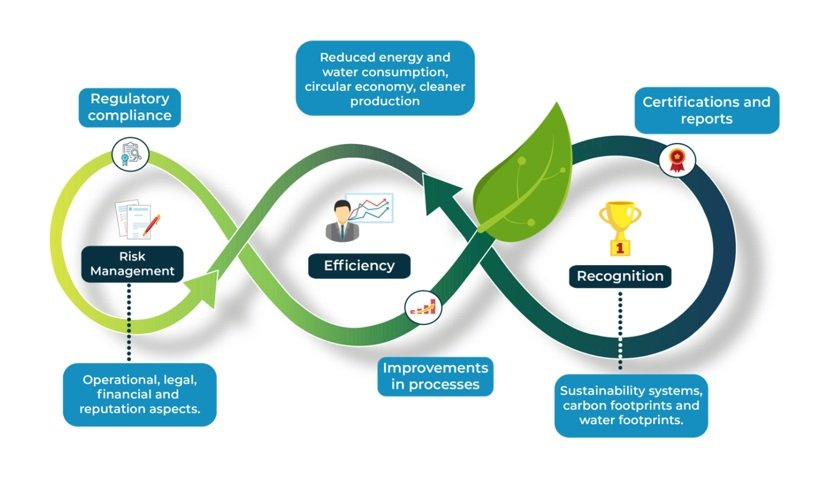
Sustainability Pathway: Risk Management → Efficiency → Recognition
The pathway presents three dimensions that help explain how environmental management can evolve and create value within an organization. They are not necessarily isolated or strictly sequential stages; in a mature environmental management approach, all three complement one another as part of a continuous improvement process.
1. Risk Management: Understanding Risks to Operate with Greater Certainty
The first component is to understand and manage the risks associated with operations.
Regulatory compliance is an essential part of this level. Identifying applicable environmental requirements, permits, records, reports, and controls establishes a sound basis for operations and helps reduce uncertainty associated with potential deviations.
But risk management goes well beyond compliance. An environmental aspect can also become an operational, financial, or reputational risk.
A failure in a control system can affect operational continuity. A spill may require resources for response and cleanup. Poor waste management can increase costs. And weak environmental performance can affect relationships with customers, regulators, and other stakeholders.
| The question is no longer only “What do we need to comply with?” It evolves into: “What could affect our operations, and how can we anticipate it?” |
This shift in perspective helps move the organization from a primarily reactive approach to a preventive one. Environmental management then begins to provide something fundamental to any organization: a greater ability to anticipate.
2. Efficiency: Doing More with Less and in a Cleaner Way
Once the organization understands its main environmental aspects and risks, a second opportunity emerges: using that information to improve processes.
| Can we do it better? |
Water, energy, and raw material consumption; waste generation; product losses; and equipment efficiency stop being viewed only as environmental indicators. They can also become indicators of operational efficiency.
Consider a simple example. A company identifies that part of a raw material regularly ends up as waste.
A response focused only on waste management would aim to ensure proper storage, transportation, treatment, or disposal. An efficiency-oriented approach would go one step further: Why is the waste being generated? Can it be reduced? Is there a loss within the process?
That waste does not represent only a disposal cost. The organization likely paid to purchase, transport, store, and process a material that ultimately did not become part of the product and must now be managed as waste. The environmental indicator may therefore be revealing an operational improvement opportunity at the same time.
This logic is directly related to the Pollution Prevention (P2) concept promoted by EPA, which prioritizes preventing or reducing pollution at the source before relying on treatment, control, or disposal.
According to EPA’s Toxics Release Inventory (TRI) National Analysis, 1,770 facilities reported 3,690 new source reduction activities in 2023, with process and equipment modifications among the most frequently reported categories.
| Environmental opportunities are not necessarily found at the end of the process. Many are found within the process itself. |
Reducing water and energy consumption, decreasing waste generation, optimizing raw material use, improving equipment, and incorporating cleaner production practices can generate environmental and operational benefits at the same time.
That is why one particularly valuable question for any organization is: What are our environmental indicators telling us about the efficiency of our operations?
3. Recognition: Turning Environmental Performance into Value
When environmental management is sustained over time and begins to generate results, a third dimension emerges: the ability to demonstrate that performance and turn it into trust and value for the organization.
This is where management systems and certifications, sustainability reports, environmental indicators, carbon and water footprints, reduction targets, and other tools can help measure, communicate, and demonstrate progress.
However, recognition should not be understood only as obtaining a certification or publishing a report. It also means building trust.
- Customers looking for responsible suppliers.
- Organizations that incorporate environmental criteria into their supply chains.
- Investors and business partners that evaluate the performance of the companies they work with.
- Employees who expect consistency between corporate commitments and the way the organization operates.
- Regulators and communities that value organizations capable of demonstrating control and responsibility for their impacts.
At this point, environmental management begins to extend beyond operations and can contribute to business positioning and competitiveness.
Strong environmental management can translate into more stable and efficient processes, greater traceability, stronger stakeholder relationships, lower risks and costs, a stronger reputation, and greater competitiveness.
Environmental Management Happens Across the Organization
Advancing along this pathway requires understanding something fundamental: environmental management does not belong exclusively to the EHS department. Many of the decisions that determine environmental performance are made every day in other areas of the organization.
Production directly influences consumption, waste, emissions, and operating conditions.
Maintenance and engineering affect equipment, infrastructure, and control systems.
Procurement influences the selection of raw materials, chemicals, equipment, and suppliers.
Logistics influences storage and material handling.
Finance and senior management participate in investment prioritization and resource allocation.
EHS or the environmental function provides technical knowledge, identifies requirements, evaluates risks, establishes controls, and coordinates environmental management.
The environmental function can coordinate management, but it cannot execute it alone. True integration occurs when different areas understand how their decisions can influence environmental performance and begin to incorporate environmental considerations into their own processes.
How Integrated Is Environmental Management in Your Organization?
A few simple questions can help assess this:
- Are environmental considerations evaluated before processes, equipment, or production capacity are modified?
- Do production, procurement, maintenance, and engineering understand the environmental implications of their decisions?
- Does the organization use information on consumption, waste, emissions, or discharges to identify efficiency opportunities?
- Does senior management receive environmental information that is useful for decision-making?
- Does the organization mainly manage impacts after they occur, or does it also analyze how to prevent them at the source?
The answers can help identify where the organization is on its own pathway and, most importantly, where opportunities exist to move forward.
Beyond Compliance
Regulatory compliance will remain a fundamental condition of responsible environmental management. But it does not have to be the end point.
Integrated environmental management enables an organization to move from Risk Management, where risks are understood and controlled; to Efficiency, where environmental information helps optimize processes and resources; and finally to Recognition, where demonstrated performance can strengthen trust, positioning, and competitiveness.
| The question should no longer be only “Are we compliant?” We should also ask: “Are we using environmental management to operate better?” |
When environmental information helps anticipate risks, prevent impacts, reduce losses, use resources more efficiently, and support better-informed decisions, environmental management stops functioning only as a compliance mechanism. It becomes a business management tool.
| Environmental management is not just another requirement; it is a tool for efficiency, protection, and competitiveness. |
Reference Sources
U.S. Environmental Protection Agency (EPA). Environmental Management Systems (EMS).
U.S. Environmental Protection Agency (EPA). Pollution Prevention (P2).
U.S. Environmental Protection Agency (EPA). Toxics Release Inventory (TRI) National Analysis – Source Reduction Activities.