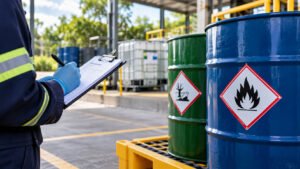
Why a Leak, a Fire, or an Explosion Is Always an Environmental Incident
Here’s a thought experiment: A pipe ruptures at your facility. Hazardous material releases. Your team springs into action, contains the spill, and no one gets hurt. Success, right?
Not exactly. Because even if no one visits the hospital, the environment just got sick.
For decades, companies treated process safety and environmental management as separate universes. Process safety lived in operations, worrying about explosions and chemical releases. Environmental management lived in compliance, worrying about permits and paperwork. They rarely spoke. They rarely shared data. They rarely realized they were protecting the same thing.
Here’s the truth they’re finally learning: Every process safety incident is an environmental incident. And every environmental manager should care deeply about how process safety is managed.
The Inconvenient Truth: Process Safety Failures Don’t Stay in the Plant
When a process safety event occurs, a runaway reaction, a tank overpressure, a valve failure, the immediate concern is human life. That’s right and proper. But what happens next?
That released chemical doesn’t disappear. It goes somewhere. Into the soil. Into the groundwater. Into the air. Into the community.
The Data Point: The American Chemistry Council (ACC) tracks process safety events through its Responsible Care program. In 2025, ACC members reported a record low number of Tier 1 process safety events, the most serious category. Since 2017, they’ve reduced these events by 22%.
Why does this matter for environmental managers? Because every one of those prevented events was also a prevented environmental release. Fewer process safety incidents mean fewer spill reports, fewer remediation projects, and fewer community notifications.
The Integration Opportunity: One System, Multiple Benefits
Here’s what leading organizations are discovering: managing process safety and environmental protection through separate systems is inefficient, redundant, and risky.
The CCPS Framework: The Center for Chemical Process Safety (CCPS) has long advocated for integrating process safety, environmental, and quality management systems. Their guidance, “Integrating EHS Management Systems,” explains how integration reduces cost through fewer management steps and avoidance of redundancy. More importantly, it results in more effective programs because best practices can be combined into a single process.
Real-World Example: When LanzaJet built a new synthetic organic chemical manufacturing facility, they didn’t silo their safety and environmental work. Trinity Consultants brought together environmental consulting, process safety management (PSM), and industrial hygiene teams to work in parallel. The result? Adherence to OSHA’s PSM standards and EPA’s Risk Management Plan (RMP) regulations, all while ensuring environmental compliance from day one.
The Lesson: Integration isn’t just theory. It’s happening, and it’s working.
The Digital Transformation: How Technology Is Bridging the Gap
Technology is accelerating the marriage of process safety and environmental management.
The DNV-EGPC Partnership: In March 2025, DNV and the Egyptian General Petroleum Corporation (EGPC) signed an agreement to develop an Integrated Governance Framework for HSE, Process Safety, and Sustainability. They’re deploying digital solutions including Synergi Life (a risk management platform) and an HSE AI Advisor that provides real-time monitoring, predictive analytics, and AI-driven insights.
Why This Matters: When process safety and environmental data live in the same digital ecosystem, patterns emerge. A near-miss in process safety becomes a predictor of potential environmental risk. Real-time monitoring catches both safety and environmental issues before they escalate.
The Korean Example: Noroo Paint won the grand prize at the “2025 PSM Best Practices Competition” for implementing AI-based smart safety technologies. Their toolkit includes AI chatbots, safety and environment kiosks, AI drones, and mobile CCTV that detect and address hazards in real time. They even introduced mobile ionizers to reduce static electricity risk in powder processes, a process safety improvement with direct environmental benefits.
The Translation: When you can see problems coming, you can stop both safety incidents and environmental releases.
The Synergy in Action: When Safety Investments Pay Environmental Dividends
Sometimes the link between process safety and environmental management produces surprising results.
The Grandperspective Case Study: A German chemical manufacturer already had strong process safety systems in place. But they wanted more visibility. They installed scanfeld® sensors, hyperspectral imaging combined with Fourier-Transform Infrared (FTIR) remote sensing, that can detect and quantify more than 400 compounds across three square kilometers.
What They Found: During testing, they detected hydrochloric acid (HCl) forming during the decomposition of another product. Concentrations started at zero and rose, proving the HCl was actively forming, not just residual from previous releases. This insight allowed the safety team to update process safety frameworks across the plant.
The Environmental Angle: By understanding chemical behavior at this granular level, they can prevent releases before they happen. Process safety visibility becomes environmental protection.
The Chinese Research: Quantifying the Link
Researchers are putting numbers on this relationship. A 2025 analysis of安全管理提升 (safety management improvement) on EHS systems found concrete examples of synergy.
The Case: An energy company began linking safety绩效考核 (performance evaluations) with environmental investment. When they upgraded safety protection in a storage tank area, they simultaneously installed a volatile organic compound (VOC) recovery system.
The Results:
- Safety risk reduced by 37%
- VOC emissions reduced by 42%
The Takeaway: A single capital project, designed with both safety and environmental goals in mind, delivered double the value.
The New Visibility: Seeing the Unseen
Traditional process safety monitoring has limitations. Fixed-point sensors only detect what reaches them. If a leak occurs in an unmonitored area, or wind carries vapors away from sensors, you might not know until it’s too late.
The Next Generation: Technologies like Grandperspective’s scanfeld® system can detect emission rates as low as 0.05 kilograms per hour across vast areas. They create five-dimensional pictures showing a gas cloud’s length, width, height, depth, and direction of movement.
The Environmental Implication: This isn’t just process safety, it’s fugitive emissions monitoring, community protection, and climate action rolled into one.
The ACC Data: Proof That Integration Works
The American Chemistry Council’s Responsible Care program provides the most compelling evidence that process safety and environmental performance move together.
The Five-Year Trends (2017-2025):
| Metric | Improvement |
|---|---|
| Tier 1 Process Safety Events | 22% reduction |
| Distribution Incidents | 35% reduction |
| Total Recordable Injury Rate | 24%+ reduction |
| SOx Emissions | 45% reduction |
| NOx Emissions | 19% reduction |
| Energy Intensity | 5% reduction |
| Greenhouse Gas Intensity | 14% reduction |
| Water Consumption | 5% reduction |
The Pattern: Companies that get serious about process safety also get serious about environmental performance. The management systems reinforce each other. The culture of safety extends to environmental stewardship.
The Regulatory Connection: PSM and RMP
In the United States, the link between process safety and environmental management is literally written into law.
OSHA’s Process Safety Management (PSM) standard and EPA’s Risk Management Plan (RMP) rule are siblings. They share the same origins, the Clean Air Act Amendments of 1990, and they share the same goal: preventing catastrophic releases of hazardous chemicals.
The Practical Reality: Facilities covered by PSM are almost always covered by RMP. The same process hazard analyses that identify explosion risks also identify release scenarios that could harm the environment. The same management of change procedures that prevent safety incidents also prevent environmental incidents.
The Lesson: If you’re managing PSM compliance, you’re already doing environmental protection work. The question is whether you’re connecting the dots.
The Ecopetrol Example: Integrity Programs Work
Colombia’s Ecopetrol provides a powerful case study in how process safety investments reduce environmental incidents.
The Strategy: They focused on integrity management, keeping lines updated, ensuring criticality assessments, developing preventive inspection and maintenance plans, and monitoring the health of high-impact lines.
The Results:
- From 2022 to 2024, they replaced more than 200 km of lines
- Operational spills dropped by 48.8% compared to 2023
- Spill volume decreased 87.7% from 2022 and 95% from 2021
- Their spill performance index was 98.5% below the global industry average
The Connection: This wasn’t an environmental program. It was an integrity program, a process safety initiative, that produced dramatic environmental results.
Practical Steps: Bringing Process Safety and Environmental Management Together
1. Map Your Intersections
Walk through your facility and identify every point where process safety and environmental concerns overlap. Storage tanks? Both. Transfer points? Both. Chemical unloading areas? Both. Create a joint risk register.
2. Share Your Data
Process safety near-misses often contain environmental warnings. Environmental monitoring data often reveals process safety vulnerabilities. Create regular meetings where both teams share what they’re seeing.
3. Integrate Your Audits
When you audit process safety, include environmental lenses. When you audit environmental compliance, include process safety perspectives. One set of findings, one corrective action plan.
4. Train Together
Process safety training should include environmental consequences. Environmental training should include process safety fundamentals. Your people need to see the whole picture.
5. Invest in Technology
Consider systems that serve both masters. Real-time monitoring, predictive analytics, and integrated risk management platforms pay dividends on both sides of the house .
6. Learn from Incidents Together
When something goes wrong, even a near-miss, investigate with both safety and environmental experts at the table. The root causes are often the same. The fixes should be too.
The Bottom Line
Process safety and environmental management have been artificially separated for too long. They share the same hazards, the same facilities, the same chemicals, and the same goal: preventing harm.
The data is clear:
- Companies that improve process safety see environmental improvements
- Integrated projects deliver double the value
- Integrity programs reduce both safety risks and environmental releases
- New technologies serve both masters
The conclusion is inescapable: If you’re an environmental manager, you need to care about process safety. Not because it’s someone else’s problem, but because it’s yours.
Every process safety event that doesn’t happen is an environmental release that never occurs. Every near-miss you investigate together is a lesson that protects both people and the planet. Every dollar invested in process safety is a dollar that doesn’t have to be spent on cleanup, remediation, and community relations.
The question isn’t whether process safety and environmental management are connected. They always have been. The question is whether you’re managing them that way.
At Enviro-Mental Corp, we are committed to being your go-to resource for environmental management. Our expertise in Texas environmental regulations and management programs makes us the ideal partner for businesses looking to improve their compliance and sustainability efforts. We provide the tools and support you need to comply with all Texas environmental regulations. Trust us to deliver effective and sustainable environmental solutions that drive your business forward.