Hazardous waste regulations in the United States
In the United States, hazardous waste management is primarily regulated under the Resource Conservation and Recovery Act (RCRA), which establishes the federal framework for managing these wastes from generation through treatment and final disposal.
The U.S. Environmental Protection Agency (EPA), together with the appropriate state authorities, establishes requirements for identifying, classifying, accumulating, transporting, and managing hazardous waste generated by industrial activities.
These requirements are primarily set out in Title 40 of the Code of Federal Regulations (40 CFR), particularly Parts 261 and 262, which address hazardous waste identification and generator responsibilities.
A fundamental principle of RCRA is the “cradle-to-grave” approach. It is intended to maintain oversight of hazardous waste from the time it is generated until it reaches an appropriate final management destination.
Consequently, a facility’s environmental responsibility extends beyond hiring a company to remove its waste. It also includes properly identifying waste, establishing appropriate handling practices, and meeting applicable requirements throughout the management process.
Hazardous waste management is a regulatory obligation that begins at the point of generation.
Proper waste identification is the first step
Industrial facilities may generate hazardous waste through activities that are not necessarily part of their primary manufacturing process.
For example, maintenance, painting, equipment cleaning, surface treatment, and chemical handling can generate spent solvents, coating residues, contaminated materials, or chemical solutions that require a hazardous waste determination.
However, not all of these wastes are automatically classified as hazardous.
Under RCRA, identification involves determining whether a material is a solid waste for regulatory purposes and whether it is a listed hazardous waste or exhibits one or more regulated hazardous characteristics.
These characteristics include:
- Ignitability: wastes that can ignite under specified conditions.
- Corrosivity: wastes with corrosive properties that meet the applicable regulatory criteria.
- Reactivity: wastes that can undergo dangerous reactions under certain conditions.
- Toxicity: wastes that can release certain contaminants above established regulatory thresholds.
The determination should be based on reliable information about the process, waste composition, and waste characteristics, supported by testing when necessary.
A Safety Data Sheet (SDS) can provide useful information, but it does not, by itself, replace the regulatory hazardous waste determination.
Incorrect identification can lead to storage, transportation, or disposal practices that do not match the material’s hazards or applicable requirements.
The amount generated also determines regulatory obligations
U.S. federal regulations establish different categories of hazardous waste generators. These categories help define obligations based on the amounts and types of waste generated.
In general, EPA recognizes three categories:
Very Small Quantity Generators (VSQGs): facilities that generate very small quantities of hazardous waste within regulatory limits.
Small Quantity Generators (SQGs): facilities that generate intermediate quantities and must meet specific requirements for identification, accumulation, handling, emergency preparedness, and waste tracking.
Large Quantity Generators (LQGs): facilities that generate larger quantities and are subject to more extensive requirements for waste management, personnel training, emergency preparedness, recordkeeping, and reporting.
Generator category is determined by the quantities generated during each calendar month and also takes into account certain acutely hazardous wastes.
For this reason, knowing how much waste is generated is just as important as understanding its characteristics.
A production change, an unusual maintenance activity, or an equipment cleanout may temporarily increase waste generation and make it necessary to reassess the facility’s generator category.
The amount of hazardous waste generated directly affects the responsibilities a company must meet.
How hazardous waste should be managed
Once waste has been identified and the generator category determined, the facility should establish procedures to manage the waste in accordance with applicable requirements.
Management begins by segregating and identifying waste at the point of generation, avoiding unnecessary mixing, and using containers suitable for the waste’s characteristics.
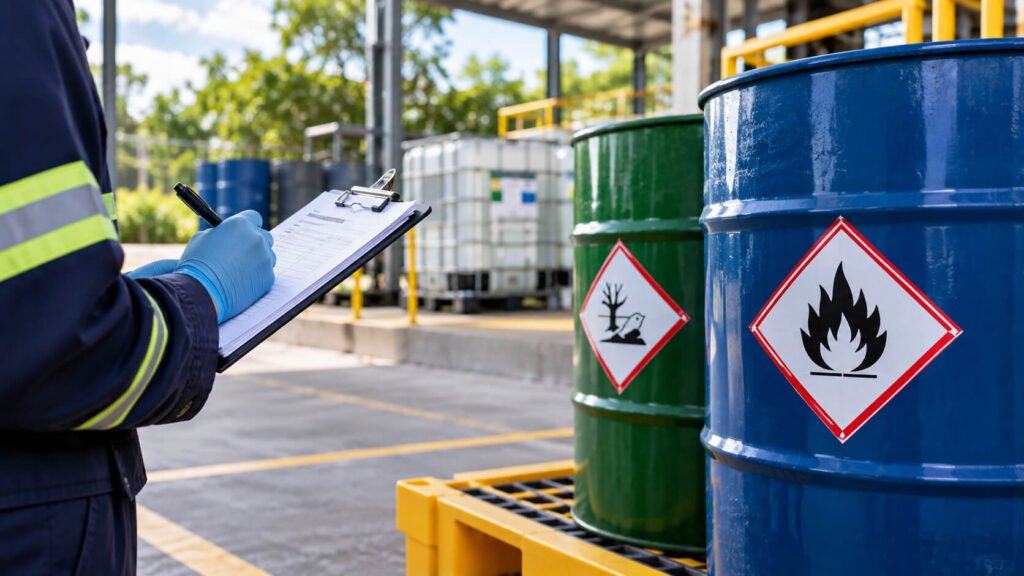
During accumulation, facilities must follow the relevant regulatory conditions, which may include labeling, material compatibility, container integrity and closure, inspections, and time or quantity limits (40 CFR 262.16 and 262.17).
For certain generator categories, facilities must also implement emergency preparedness and response measures and ensure that personnel understand the procedures relevant to the waste they handle.
When waste leaves the facility, applicable transportation requirements must be followed, and waste must be delivered to facilities authorized to receive it.
For shipments subject to the federal manifest system, the Hazardous Waste Manifest documents and tracks the movement of waste from the generator to the receiving facility.
Records relating to waste generation, classification, accumulation, and shipment are an important part of environmental oversight and demonstrating compliance.
Proper management is not simply about removing waste from a facility; it is about maintaining control at every stage of the process.
Environmental and legal risks of improper management
Hazardous waste may contain substances capable of affecting soil, water, or air when handled improperly.
For example, storage in damaged containers, mixing incompatible wastes, or failing to implement preventive measures can contribute to leaks, spills, or unintended reactions.
Beyond their potential environmental consequences, these situations may constitute violations of obligations under RCRA and applicable state regulations.
During inspections and compliance oversight, authorities may review waste identification, accumulation conditions, records, manifests, and compliance with requirements for the facility’s generator category.
Depending on the nature and severity of a violation, consequences may include corrective requirements, administrative measures, and civil penalties. Certain conduct may also result in criminal liability under applicable law.
However, the purpose of proper management is not solely to avoid penalties.
Properly identifying and managing waste helps prevent environmental impacts, improve operational control, and strengthen regulatory compliance.
Waste management must evolve with operations
Waste generation conditions can change over time.
Introducing new raw materials, modifying processes, replacing chemicals, or conducting unusual maintenance activities can create new waste streams or change their quantities and characteristics.
For this reason, it is important to maintain an up-to-date waste inventory and periodically review hazardous waste determinations and generator category.
Coordination among production, maintenance, purchasing, and environmental teams helps identify changes early and establish the appropriate management measures.
An up-to-date inventory, supported by reliable records and procedures understood by personnel, makes it easier to track waste from generation through shipment.
Best practices for strengthening hazardous waste management
Industrial facilities can strengthen waste management by identifying all waste streams, documenting their characteristics, and periodically verifying the quantities generated.
It is also important to maintain organized accumulation areas, suitable containers, labeling and segregation procedures, and controls aligned with applicable regulatory requirements.
Personnel training, record reviews, and verification of transporters and receiving facilities help maintain traceability and reduce handling risks.
Finally, states may establish requirements that are additional to or more stringent than federal rules. Each facility should therefore review the specific requirements of its jurisdiction.
Hazardous waste management should be part of routine business operations, rather than an activity addressed only before an inspection or when scheduling waste pickup.
Knowing what waste is generated, how it must be managed, and which requirements apply is the foundation of responsible environmental management and regulatory compliance.
Abbreviations
EPA: U.S. Environmental Protection Agency
RCRA: Resource Conservation and Recovery Act
CFR: Code of Federal Regulations
VSQG: Very Small Quantity Generator
SQG: Small Quantity Generator
LQG: Large Quantity Generator
Sources
- U.S. EPA. Resource Conservation and Recovery Act (RCRA) Overview.
- U.S. EPA. Learn the Basics of Hazardous Waste.
- U.S. EPA. Defining Hazardous Waste: Listed, Characteristic and Mixed Radiological Wastes.
- U.S. EPA. Categories of Hazardous Waste Generators.
- U.S. EPA. Hazardous Waste Manifest System.
- U.S. EPA. Waste, Chemical, and Cleanup Enforcement.
- U.S. EPA. State Authorization under the Resource Conservation and Recovery Act (RCRA).
- Code of Federal Regulations. 40 CFR Part 261 — Identification and Listing of Hazardous Waste.
- Code of Federal Regulations. 40 CFR Part 262 — Standards Applicable to Generators of Hazardous Waste, including § 262.11 (hazardous waste determination), § 262.16 (SQG conditions) and § 262.17 (LQG conditions).
- Texas Commission on Environmental Quality (TCEQ). Industrial and Hazardous Waste Registration and Reporting: Am I Regulated?